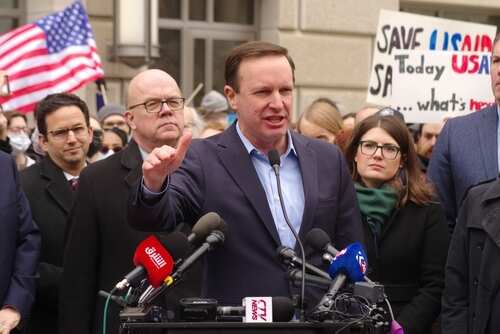
(DailyAnswer.org) – Chris Cuomo left jaws on the floor this week after telling Senator Chris Murphy he’s officially persona non grata on his show for turning a Texas tragedy into yet another partisan blame game, because apparently, nothing unites America like using disaster victims as political talking points.
At a Glance
- Chris Cuomo publicly rebuked Sen. Chris Murphy for blaming Trump-era budget cuts for the Texas flood disaster.
- Murphy’s claims about federal funding cuts were contradicted by the National Weather Service union, which stated staffing was adequate.
- The exchange highlights growing public frustration with politicians exploiting tragedies for partisan advantage.
- Media outlets widely covered Cuomo’s sharp criticism and his call for more responsible, fact-based discourse.
Cuomo Draws a Red Line: No More Politicizing Tragedy
Chris Cuomo, host of NewsNation’s “Cuomo,” wasn’t about to let Senator Chris Murphy (D-CT) waltz onto his show and use the Texas flash floods as a political prop. On live television, Cuomo called out Murphy for what he described as a “cheap shot at dead kids,” after the senator claimed Trump-era budget cuts to agencies like the National Weather Service were to blame for the disaster. Cuomo’s rebuke was as direct as it gets: “If that’s how you’re going to play it, you’re not welcome here.” It’s a rare sight in today’s media landscape, but one that resonates with Americans who are fed up with politicians using tragedy as a campaign ad.
Murphy’s original tweet, posted in the immediate aftermath of the deadly Texas floods, claimed, “Accurate weather forecasting helps avoid fatal disasters. There are consequences to Trump’s brainless attacks on public workers, like meteorologists.” Cuomo didn’t mince words when responding, pointing out that the National Weather Service union itself said staffing was fully adequate during the emergency, and that the agency had issued robust warnings well before the waters rose. “You’re not going to score points on the backs of these families,” Cuomo declared, signaling that there’s at least one newsman left who won’t let politicians use American suffering to move the polls.
Partisan Blame Games Reach New Lows
Watching politicians race to assign blame after every disaster has become a tired, infuriating ritual. This time, however, the spectacle hit a new low. Rather than focusing on recovery or accountability for actual failures, Murphy and other Democratic leaders immediately tried to weaponize the Texas floods against their political rivals. The facts just didn’t back them up. The National Weather Service union, which represents the very meteorologists Murphy claimed were crippled by budget cuts, said there were no staffing shortfalls during the crisis. The warnings were issued, the protocols followed. But when did facts ever get in the way of a good political soundbite?
The Texas community, meanwhile, faced the grim reality of recovery while national leaders bickered over whose administration was to blame. For viewers at home, the spectacle was as predictable as it was exhausting: another tragedy, another round of finger-pointing, and another opportunity for politicians to avoid responsibility for decades of bipartisan mismanagement. Cuomo’s on-air rejection of Murphy’s tactics spoke to a deeper frustration, one shared by millions of Americans who want leaders to solve problems, not exploit them for cable news hits.
Media Accountability and the Decline of Trust
Cuomo’s evisceration of Murphy isn’t just about one senator or one disaster; it’s about the broader crisis of trust in both media and politics. Every time a public figure rushes to the nearest microphone to blame their opponents for natural disasters, confidence in both institutions erodes further. News outlets, those that still care about facts, anyway, have highlighted the danger of this endless blame game. When tragedy strikes, Americans want action and answers, not campaign rhetoric or political theater.
The fallout from this episode could have lasting consequences. Public discourse has once again shifted from helping flood victims to scoring partisan points. Worse, the actual causes of disaster, poor infrastructure, bureaucratic incompetence, or even climate factors, are drowned out by the din of political posturing. If leaders can’t resist the urge to weaponize suffering, they shouldn’t be surprised when the public tunes out entirely. Cuomo’s stand may be rare, but it’s a reminder of what media accountability could, and should, look like.
Copyright 2025, DailyAnswer.org