

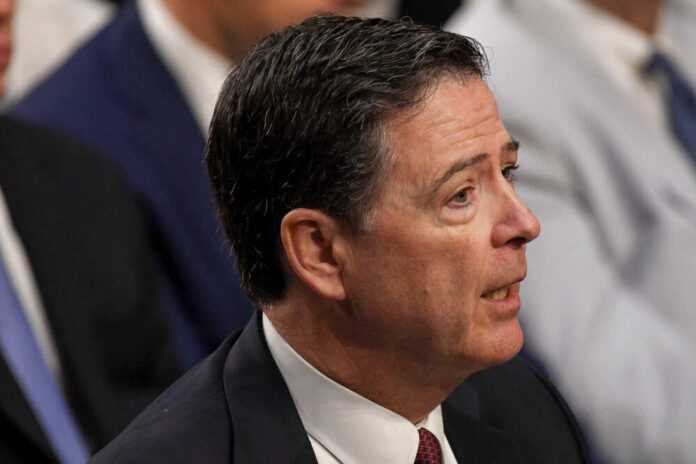
(DailyAnswer.org) – When James Comey, a former FBI Director, publicly outed himself as a Taylor Swift “Swiftie” while slamming Donald Trump, he didn’t just blend pop culture and politics, he ignited a new kind of public spectacle that leaves Americans wondering where the line between fandom and political persuasion truly lies.
Story Snapshot
- James Comey revealed his family’s obsession with Taylor Swift and their dedicated group chat.
- Comey used Swift’s lyrics as a framework for criticizing Donald Trump and American politics.
- The video’s bizarre fusion of personal pop culture with pointed political commentary set social media ablaze.
- Comey’s move exemplifies the growing trend of political figures leveraging celebrity influence to shape discourse.
Comey’s Swiftie Confession and Political Messaging Collide
On August 17, 2025, James Comey released a video that instantly became the talk of cable news and social feeds. In the video, Comey confessed to being a proud “Swiftie,” revealing that his family runs a group chat devoted solely to Taylor Swift’s music and persona. This wasn’t just a quirky personal reveal; it was a calculated move anchoring his criticism of Donald Trump within the cultural context of Swift’s lyrics, specifically referencing her advice on how to handle bullies. The delivery was personal, but the message was unmistakably political, leveraging Swift’s popularity to draw attention to his ongoing feud with Trump and America’s current political climate. The spectacle of a former FBI Director framing his political views through pop idol fandom blurred boundaries and sparked instant debate about the seriousness and sanity of modern political communication.
Comey’s video not only humanized him with a relatable family anecdote but also raised questions about the appropriateness of such pop culture references in high-stakes political discourse. Critics called the video “bizarre,” highlighting the unusual intersection of personal obsession and public platform. The revelation of a Swift-inspired family group chat painted Comey as both an ordinary father and a public figure unafraid to weave pop culture into the fabric of political critique. Fox News and other outlets quickly confirmed the details, quoting Comey’s direct remarks and broadcasting segments dissecting the video’s intent and impact. This blending of entertainment and political messaging signals a strategic shift, where relatability and cultural touchstones are used to amplify criticism and connect with audiences otherwise disengaged from traditional politics.
The Pop Culture-Politics Nexus: A New Playbook for Public Figures
Comey’s strategy reflects a broader trend: the increasing use of celebrity influence and pop culture references in political messaging. Taylor Swift, long known for her apolitical stance, has in recent years become an outspoken advocate for progressive causes and a vocal critic of Donald Trump. By positioning himself as a member of Swift’s fanbase, Comey taps into her cultural capital and her ability to mobilize younger voters and sway public opinion. Political figures now routinely invoke celebrities to bolster their arguments, humanize their personas, and distract from policy specifics. This practice, while effective at capturing fleeting attention spans, risks trivializing serious issues by framing them as extensions of celebrity drama.
The video’s timing and content are no accident. Comey’s dismissal by Trump in 2017 set the stage for years of public sparring, and Swift’s own evolution from pop star to political influencer has made her a lightning rod for partisan commentary. By merging his personal admiration for Swift with his professional disdain for Trump, Comey creates a narrative that is both accessible and provocative. The video’s reception, ranging from amused approval among Swift fans to skeptical outrage among Trump supporters, underscores the deepening polarization that celebrity involvement can intensify. Media analysts point to the effectiveness of such strategies in reaching audiences who might otherwise tune out political news, while scholars warn about the blurring of lines between entertainment and governance.
Ripple Effects: Shifting Discourse and Partisan Fault Lines
Comey’s video has immediate and long-term implications for political communication in America. In the short term, it has generated extensive media coverage and social media engagement, with commentators dissecting every aspect from the “Swiftie” confession to the pointed anti-Trump rhetoric. For Swift fans, the event is another sign of their idol’s cultural reach; for political observers, it is a case study in the weaponization of celebrity fandom. The broader public is left to grapple with whether such tactics bring clarity or confusion to an already noisy political landscape.
Former FBI Director James Comey confesses he's a 'Swiftie' in new anti-Trump video message https://t.co/w8pPVIb0u0
— Fox News (@FoxNews) August 18, 2025
In the long run, Comey’s maneuver may accelerate the mainstreaming of pop culture in political messaging, setting precedents for future candidates and commentators. The use of relatable anecdotes and popular music as vehicles for serious critique appeals to the emotional instincts of audiences, but also risks undermining the gravitas of political debate. As the boundaries between personal fandom and public responsibility continue to erode, American voters must decide whether they are moved by the substance of the message or merely entertained by its delivery. The story of James Comey, Swiftie and political provocateur, is a vivid illustration of this new era, one where the soundtrack of democracy is increasingly set by the pop charts.
Copyright 2025, DailyAnswer.org