
(DailyAnswer.org) – When New York City’s mayor publicly backs a scandal-tested ex-governor to block a radical challenger, the city’s political chessboard erupts with intrigue, exposing the raw fault lines dividing Democrats, and leaving voters to wonder what, exactly, is at stake.
Story Highlights
- Mayor Eric Adams endorsed Andrew Cuomo for mayor, directly confronting Zohran Mamdani’s progressive challenge.
- Accusations of antisemitism and divisive politics have escalated campaign tensions and polarized key voting blocs.
- This rare alliance between Adams and Cuomo signals establishment Democrats’ determination to halt left-wing momentum.
- The endorsement’s timing, days before early voting, aims to sway undecided voters and consolidate support.
Adams and Cuomo Forge a Strategic Alliance to Counter Mamdani
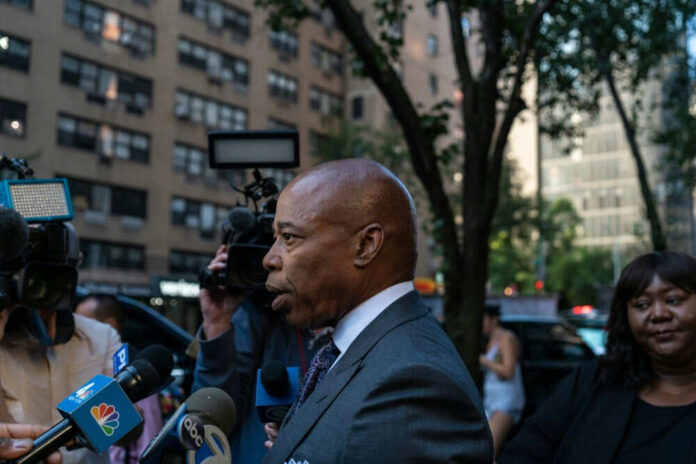
Mayor Eric Adams startled New Yorkers by announcing his endorsement of former Governor Andrew Cuomo in the city’s mayoral race, a move calculated to sideline progressive upstart Zohran Mamdani. This public show of unity, formalized at a press conference in Harlem, revealed not only a strategic alliance but also the establishment’s anxiety over Mamdani’s surging influence and controversial rhetoric. Adams justified his choice by citing specific concerns, accusing Mamdani of divisive politics and insensitivity toward the city’s Jewish residents.
Cuomo, whose career was marred by scandal and resignation in 2021, has since remained a fixture in New York’s political conversation. His willingness to return to the fray, now with the sitting mayor’s endorsement, signals both his intention to rehabilitate his reputation and the establishment’s readiness to prioritize experience over ideological experimentation. The timing of the press conference, just after a heated mayoral debate and ahead of early voting, underscores the urgency felt by Adams and Cuomo to unite their bases and outmaneuver Mamdani’s grassroots momentum.
Mamdani Responds with Sharp Criticism, Framing the Endorsement as Establishment Collusion
Assembly member Zohran Mamdani wasted no time firing back. In a pointed public statement, Mamdani portrayed the Adams-Cuomo alliance as evidence of entrenched corruption and resistance to change, invoking the “billionaire class” and national party elites as hidden hands behind the maneuver. He argued that the endorsement illustrates a broader effort to suppress progressive voices, especially those advocating for marginalized communities and challenging establishment orthodoxy. Mamdani’s platform, defined by left-wing activism and outspoken support for Palestinian rights, has made him a lightning rod for criticism from mainstream Democrats and pro-Israel groups alike.
Adams and Cuomo’s criticisms of Mamdani focused on what they described as dangerous rhetoric, with Adams declaring, “When you tell Jewish residents that you need ‘globalize intifada,’ you’re saying you don’t care.” Cuomo added, “Democrats do not propose antisemitic policies. Democrats have stood with Israel always as an ally. That’s what Democrats do.” These statements were designed to drive a wedge between Mamdani and key voting blocs, leveraging fears of radicalism to rally centrist and conservative-leaning Democrats.
Escalating Tensions and Polarization Shape the Race’s Final Days
The mayoral race is now defined by sharp polarization, both within the Democratic Party and among New York’s diverse communities. Adams and Cuomo’s alliance is a rare spectacle in city politics, a sitting mayor publicly endorsing a former governor for the same office. This tactic is not without risk. While it may consolidate establishment support, it also exposes the anxiety gripping mainstream Democrats as progressive candidates gain traction. Mamdani’s rise, powered by activist networks and grassroots donors, has forced the establishment to confront uncomfortable questions about its own legitimacy and adaptability.
Jewish community organizations, alarmed by Mamdani’s past statements, have joined establishment voices in warning against his candidacy. Meanwhile, progressive activists and younger voters see the Adams-Cuomo partnership as a desperate attempt to maintain the status quo. The debate over antisemitism, Islamophobia, and corruption has spilled into the streets and social media feeds, making this election about more than just policy, it’s a referendum on the soul and future direction of New York’s Democratic Party.
The Stakes: Establishment vs. Progressive, Implications for NYC and Beyond
In the short term, Adams’s endorsement of Cuomo may succeed in sidelining Mamdani, especially among older and more moderate voters wary of radical change. If Cuomo prevails, it could reinforce establishment dominance and set a precedent for future alliances against progressives in New York and other urban centers. However, the long-term implications remain uncertain. The visible schism between party wings threatens to alienate younger voters and activists, fueling ongoing debates about representation, corruption, and democratic renewal.
As early voting begins, the city’s electorate faces a stark choice: continuity and establishment experience or a leap into progressive reform. The outcome will shape not only local governance but also the national conversation about the direction of the Democratic Party. With the lines drawn and accusations flying, New York’s mayoral race has become a microcosm of America’s broader political battle, where every endorsement, every debate, and every alliance matters.
Copyright 2025, DailyAnswer.org