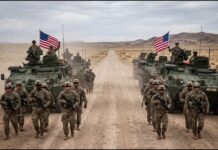
(DailyAnswer.org) – The Pentagon’s decision to pull 5,000 U.S. troops from Germany shows how fast a decades-old alliance can turn into leverage when America is at war and allies won’t fully show up.
Quick Take
- The Pentagon says about 5,000 troops will leave Germany over the next 6–12 months after a force-posture review.
- The drawdown follows an escalating public clash between President Trump and German Chancellor Friedrich Merz tied to NATO support levels during the U.S.-Iran war.
- Officials describe the move as meeting “theater requirements,” with some units potentially returning to the U.S. and later shifting toward the Indo-Pacific.
- The withdrawal is smaller than Trump’s 2020 Germany drawdown plan but still affects a major hub that supports U.S. operations across Europe and the Middle East.
Pentagon confirms a 6–12 month drawdown from Germany
Pentagon spokesman Sean Parnell confirmed that roughly 5,000 U.S. troops will be withdrawn from Germany over the next six to 12 months, following what the Pentagon describes as a broad force-posture review. Reporting indicates the change involves a brigade-sized element and includes adjustments such as reassignment of a long-range fires battalion. Officials also indicated the Landstuhl Regional Medical Center is not expected to be affected by the move.
Germany has hosted U.S. forces since World War II, and current totals have been reported in the mid-to-high 30,000s. Major installations, including Ramstein Air Base, function as critical logistics and command nodes for U.S. European Command and for moving personnel and equipment. That reality is why even a partial reduction gets attention: a troop shift is not simply a political signal; it can change how quickly the U.S. can surge capability into Europe or onward into the Middle East.
The Trump–Merz feud puts NATO burden-sharing back on the table
Reporting links the withdrawal to an intensifying dispute between President Trump and Chancellor Merz after Merz criticized U.S. handling of the Iran conflict, describing the U.S. as being “humiliated” and lacking strategy. Trump responded publicly on Truth Social, accusing Merz of effectively enabling Iran’s nuclear ambitions and later floating the idea of reducing the U.S. footprint in Germany. Within days, the Pentagon announced the drawdown plan.
This sequence matters because it highlights a recurring fault line: Washington provides the backbone of NATO’s high-end military capability, but U.S. leaders of both parties have repeatedly pressed European capitals to carry more of the load. Conservatives tend to see this as a basic fairness issue—American taxpayers underwrite security while domestic needs pile up at home. Critics argue troop moves risk destabilizing deterrence, yet Pentagon messaging emphasizes requirements rather than an abandonment of Europe.
What changes operationally—and what still looks uncertain
Officials and defense reporting suggest the near-term security impact in Europe may be limited, in part because European allies have increased certain defense investments since Russia’s invasion of Ukraine. At the same time, uncertainty remains about which units depart, where they go, and how quickly replacements could flow back if the threat picture changes. Some reporting suggests troops may return stateside before redeploying, potentially to the Indo-Pacific.
The domestic political subtext: “America First” meets institutional guardrails
The drawdown also revives a familiar Washington tension: how much authority a president should have to use basing decisions to pressure allies. Trump pursued a much larger Germany drawdown in 2020, but Congress pushed back, and the plan was later reversed under President Biden. Today, Congress remains a check on more dramatic alliance moves; reporting notes a law requiring congressional approval for a NATO exit. That limits worst-case scenarios, even as rhetoric heats up.
Why this story resonates beyond Europe
For many Americans—right and left—the bigger storyline is government credibility. If U.S. force posture is repeatedly reshuffled by political conflict rather than transparent strategy, voters tend to suspect the process serves insiders more than citizens. Supporters of the administration see a rational demand for allied seriousness during wartime and a shift toward priorities like homeland defense and the Indo-Pacific. Opponents see volatility. What’s clear is that alliances now operate in a more transactional, less sentimental era.
Limited public detail is available so far about the exact units, final destinations, and cost implications, beyond the stated timeline and broad rationale. Those specifics will determine whether this is mostly a symbolic pressure tactic, a genuine strategic pivot, or a bit of both. Until then, the most concrete takeaway is simple: the U.S. military footprint in Germany is no longer treated as untouchable, even during an active Middle East conflict.
Sources:
Pentagon orders withdrawal of 5,000 U.S. troops from Germany as Trump escalates feud with Merz
Hegseth withdrawal U.S. troops Germany
Copyright 2026, DailyAnswer.org