
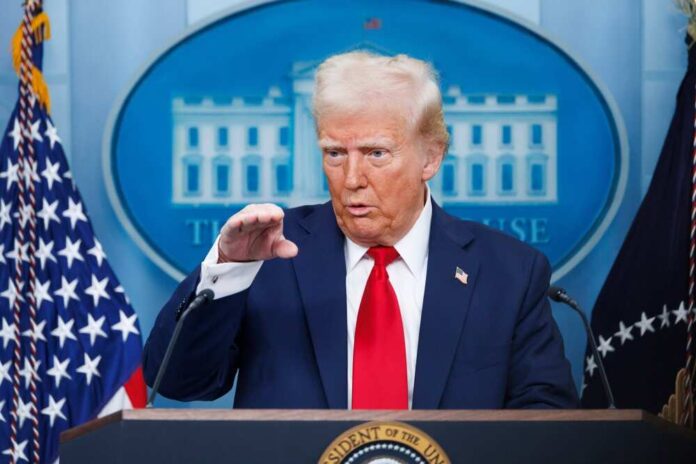
(DailyAnswer.org) – Trump’s plan to cap medical student loans at $150,000 threatens to worsen America’s looming doctor shortage crisis, as the average medical student already graduates with over $212,000 in debt.
Key Takeaways
- Trump’s FY 2026 budget proposes eliminating Grad PLUS loans and capping federal student borrowing at $150,000 for medical students
- The average medical student graduates with $212,341 in debt, while the median cost of attending public medical school is $286,000
- Republicans claim the $34.7 billion saved from cutting Grad PLUS loans would help fund tax cuts
- Medical associations warn these changes would worsen the projected shortage of 86,000 physicians by 2036
- The proposal would force future doctors to rely on high-interest private loans or abandon medical careers altogether
Trump’s Budget Ax Falls on Future Doctors
The Trump administration’s fiscal year 2026 budget proposal takes direct aim at America’s future physicians by eliminating a critical lifeline for medical students. The plan would terminate the Graduate PLUS loan program and impose a $150,000 cap on federal student borrowing for professional programs – less than half the current median cost of attending a public medical school. This drastic reduction comes at a time when the nation already faces a projected shortage of up to 86,000 physicians by 2036, threatening to create a healthcare crisis that would affect millions of Americans.
Medical organizations across the country have sounded the alarm about these proposed cuts. The American Medical Association has warned that restricting federal loans would make medical education unaffordable for many qualified students, particularly those from middle and lower-income backgrounds. The Association of American Colleges of Osteopathic Medicine noted that the proposed $150,000 cap wouldn’t even cover a single year at many medical schools, effectively pricing out talented students who lack personal wealth or family connections to secure private financing.
The Real Cost of Medical Education
The harsh reality of medical education costs makes these proposed cuts particularly devastating. Over 75% of medical students rely on federal loans, with 2024 graduates averaging $212,341 in debt. The median cost of attending a public medical school now stands at $286,000 for the full program. While tuition has seen a slight decrease from $53,582 in 2020 to $50,218 in 2025, living expenses have simultaneously risen by 11% to $21,950 annually. These figures expose the disconnect between policy proposals and economic realities facing aspiring doctors.
The Asian Pacific American Medical Student Association has emphasized that these cuts would disproportionately impact low-income and minority students, many of whom come from the 33% of medical students with Pell-eligible backgrounds. By eliminating Graduate PLUS loans, which currently allow students to borrow up to the full cost of attendance minus other aid, the administration would effectively slam the door on medical careers for thousands of qualified candidates who lack substantial personal resources.
Tax Cuts Over Healthcare Workforce
The administration’s justification for these cuts reveals a troubling prioritization of tax reductions over healthcare workforce development. Republicans claim the $34.7 billion saved from cutting Graduate PLUS loans would help fund tax cuts, effectively transferring resources from future doctors to current high-income earners. This comes alongside other controversial budget reductions, including $300 million from SNAP food assistance and Medicaid restrictions expected to remove 14 million Americans from healthcare coverage.
The administration argues these changes will pressure institutions to lower tuition, citing a 2023 National Bureau of Economic Research paper suggesting Graduate PLUS increased costs without improving access. However, medical schools counter that tuition reductions are unrealistic given rising operational costs, specialized equipment needs, and the expense of maintaining teaching hospitals. The real effect, they warn, would be fewer doctors – particularly in primary care and underserved communities.
Forcing Impossible Choices
If implemented, these loan restrictions would force aspiring physicians into a series of impossible choices. Students would need to rely on private loans with significantly higher interest rates and fewer consumer protections. Many would delay or completely abandon their medical education dreams. Others would accumulate massive credit card debt just to cover basic living expenses while studying. The result would be a medical workforce increasingly limited to those from wealthy backgrounds, undermining decades of progress in diversifying the physician population.
“The proposed cap on graduate student borrowing would have a devastating impact on the physician workforce at a time when the nation faces a significant physician shortage,” said Dr. Jesse M. Ehrenfeld, President of the American Medical Association. “This policy would disproportionately harm students from disadvantaged backgrounds and exacerbate existing inequities in healthcare access.”
With 72% of current medical students relying on federal loans, these proposals threaten to reshape America’s future physician workforce precisely when an aging population and increasing healthcare demands require more doctors, not fewer. The administration’s apparent willingness to sacrifice medical education accessibility for tax cuts reveals a disturbing disregard for the long-term healthcare needs of American citizens. As medical associations continue to fight these proposals, the future of healthcare access for millions hangs in the balance.
Copyright 2025, DailyAnswer.org