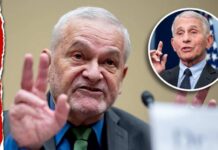

(DailyAnswer.org) – Iran’s “new” supreme leader may already be too wounded and hidden to rule—exactly the kind of instability that can drag America into a wider war if the regime lashes out.
Story Snapshot
- Ali Khamenei was killed on Feb. 28, 2026, in coordinated U.S.-Israeli strikes that also wiped out multiple senior Iranian defense and military leaders.
- Iran’s Assembly of Experts announced Mojtaba Khamenei as the new supreme leader on March 7, but U.S. officials say he is wounded, likely disfigured, and in hiding.
- The war entered its third week by mid-March, with Iran still launching strikes while the U.S. reported hitting roughly 15,000 targets inside Iran.
- Analysts warn against assuming rapid regime collapse because the IRGC remains a deeply entrenched military, political, and economic power center.
Decapitation Strike Shatters Tehran’s Command Structure
U.S. and Israeli forces targeted Iran’s top leadership on Feb. 28, 2026, killing Supreme Leader Ali Khamenei and several senior officials tied to Iran’s defense and command apparatus. Reported fatalities included the secretary of the Iranian Defence Council, the IRGC commander, the chief of the general staff, the defense minister, and the head of the supreme leader’s military office. Removing so many decision-makers at once created immediate command-and-control pressure as Iran tried to coordinate retaliation.
Iran’s leadership crisis quickly turned into a succession problem with national-security stakes. Tehran declared a 40-day mourning period and installed an Interim Leadership Council while the regime worked through the next steps. The result was a formal announcement—Mojtaba Khamenei, the late leader’s son, named as supreme leader on March 7. That timeline matters because it suggests Iran prioritized continuity on paper even while its wartime leadership was under heavy stress.
Is Mojtaba Khamenei Alive, Visible, and Actually Governing?
U.S. Defense Secretary Pete Hegseth said on March 13 that Iran’s newly announced supreme leader is “wounded and likely disfigured” and is currently in hiding. Hegseth described Iranian leaders as “desperate and hiding” and said they had “gone underground.” Those are official U.S. claims, not independent confirmation, but they directly conflict with Tehran’s attempt to project stability after the Assembly of Experts’ announcement.
Available reporting leaves a key limitation: the public still lacks direct, verifiable proof of Mojtaba Khamenei exercising day-to-day authority in a normal, visible way. According to the same U.S. account, Iranian state media has relied on cameras and recorders rather than live public appearances, which U.S. officials cite as consistent with a leader who is concealed for security or incapacitated. The U.S. also announced bounties for information on Iran’s top leaders, signaling an active effort to locate them.
War Metrics Show Escalation—And Why Americans Should Watch Closely
By mid-March 2026, the conflict had entered its third week, and Iran continued striking targets in Israel and Gulf countries. The U.S. reported hitting about 15,000 targets in Iran, underscoring the scale of the campaign. Iranian state TV also reported an explosion during an annual Al-Quds Day march in Tehran that killed at least one person. U.S. military casualties reached 13 personnel over two weeks of “Operation Epic Fury.”
For an American audience tired of forever wars, the tension here is obvious: removing terrorist-linked leadership can weaken a hostile regime, but it can also create chaos that increases miscalculation. When a country’s chain of command is degraded, field commanders and proxy networks can act independently, making deterrence harder. The research also reports Iranian deaths exceeding 1,400 by mid-March, including 53 killed at a girls’ school in the initial strikes—an indicator that civilians are bearing heavy costs.
Regime Collapse Isn’t Guaranteed Because the IRGC Still Holds Power
Analysts cited in the research caution that predictions of immediate regime collapse are likely premature, largely because the Islamic Revolutionary Guard Corps remains a powerful institution with deep political and economic stakes in preserving the system. That matters for U.S. policy: removing one figurehead does not automatically dismantle a security state. Iran could respond to leadership loss by shifting power into a more collective structure specifically designed to prevent authority from consolidating in one person again.
Strategically, the research describes Iran’s retaliation as calibrated rather than purely emotional, reflecting a preference for proportional response to avoid igniting an even broader regional war. That framework suggests the regime—or what remains of its decision-making core—may try to keep escalation within boundaries even as it seeks to save face. At the same time, international observers, including France, Russia, and the UN, warned of potential regime collapse or further escalation, highlighting the risk that instability spreads beyond Iran’s borders.
Sources:
List of Iranian officials killed during the 2026 Iran war
Iran’s supreme leader is dead. Here’s what it means.
Copyright 2026, DailyAnswer.org