

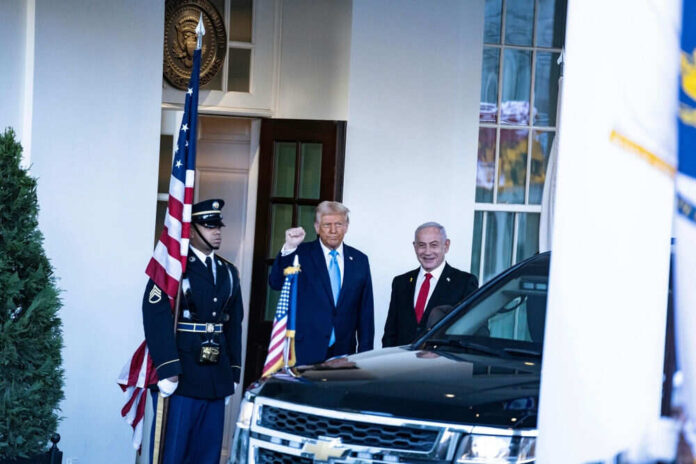
(DailyAnswer.org) – When a foreign leader declares, “You can’t be MAGA if you’re anti-Israel,” the clash between loyalty, identity, and influence within American conservatism reaches a boiling point that demands attention.
Story Snapshot
- Israeli Prime Minister Netanyahu publicly tells Trump supporters that supporting Israel is essential to being “MAGA.”
- The statement exposes and intensifies rifts within the American right over foreign policy and national allegiance.
- The MAGA movement now faces a reckoning: Can it remain unified as pro-Israel sentiment becomes a litmus test?
- This episode signals potential shifts in U.S.-Israel relations and the broader conservative agenda.
Netanyahu’s Provocation and the MAGA Identity Test
August 2025. Benjamin Netanyahu, Israel’s longest-serving prime minister, sits for an interview with Breitbart and fires the shot heard around the right-wing world: “You can’t be MAGA if you’re anti-Israel.” No ambiguity. No diplomatic hedging. A foreign leader, speaking directly to the base of a former U.S. president, draws a line in the ideological sand. The message travels instantly from headline to social feeds, igniting both applause and outrage. For a movement built on American sovereignty and skepticism of global entanglements, Netanyahu’s challenge is more than a policy debate, it’s a test of identity.
Conservative media amplifies the message, framing it as a reaffirmation of the historic U.S.-Israel alliance. Yet within MAGA circles, the question grows louder by the hour: Is support for Israel a core MAGA principle, or is the movement being pressed to serve interests outside America’s borders?
Historic Alliances Collide With New Right-Wing Realities
For decades, the American right’s bond with Israel was ironclad. Evangelical Christians, one of Trump’s most loyal demographics, see Israel’s fate as intertwined with their own. Trump’s presidency cemented this alliance: recognizing Jerusalem as Israel’s capital, moving the embassy, greenlighting the Abraham Accords. Netanyahu was a frequent guest in Trump’s White House, and the two leaders exchanged public praise. But after the Gaza war and a surge in “America First” rhetoric, some in the MAGA base began questioning endless foreign aid, including the $3.8 billion annually sent to Israel.
Among MAGA’s populists and nationalists, the old consensus frays. Voices like Tucker Carlson and select GOP representatives warn against “foreign entanglements.” Social media debates morph into shouting matches over loyalty: Is resisting foreign influence now “anti-Israel,” or is it the essence of MAGA’s America First pledge?
Power Struggles, Motivations, and the Calculus of Influence
Netanyahu’s statement is no offhand remark. He faces mounting domestic and international pressures, political unrest at home, conflict in Gaza, and uncertainty about the longevity of American support. By tying MAGA identity to support for Israel, he aims to lock in the right’s backing as the 2024 U.S. election cycle heats up. For Trump and his advisers, the calculus is delicate. Alienate the pro-Israel evangelical base, and you risk losing a crucial bloc. Push too hard against isolationists, and the movement fractures. Conservative media outlets like Breitbart seize the moment to galvanize their audience, but the risk of backlash looms.
The resulting power struggle is not just between Netanyahu and MAGA skeptics. It’s within the American right itself, between the old guard’s unwavering support for Israel and the new guard’s suspicion of any allegiance that isn’t strictly American.
Ripple Effects: Policy, Politics, and the Future of the Conservative Movement
Short-term, Netanyahu’s words have already forced a reckoning. Some MAGA loyalists double down, flooding social media with pro-Israel declarations and accusing skeptics of betraying “conservative values.” Others bristle, arguing that foreign leaders should not dictate the terms of American political identity. The pressure on Republican leadership mounts: Will the party platform enshrine support for Israel as non-negotiable, or will it pivot to accommodate the growing isolationist wing?
Long-term, the implications could be seismic. If support for Israel becomes the dividing line within the right, party unity is at risk, and the U.S.-Israel alliance could become a partisan flashpoint. Pro-Israel lobbyists, sensing the shift, intensify outreach, while America First influencers warn of “foreign interference.” Jewish and evangelical communities watch closely, aware that the outcome may reshape their own political futures. Conservative media outlets recalibrate their messaging, torn between tradition and a base that refuses to be taken for granted.
Copyright 2025, DailyAnswer.org