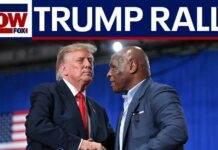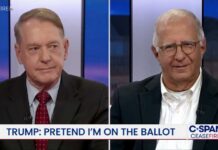

President Trump openly urged Democratic Senator John Fetterman to join Republicans, turning a rare cross-party flirtation into a national test of party loyalty.
Story Highlights
- Trump said he would “love” Fetterman as a Republican and praised his judgment.
- Trump claimed Fetterman polls better as a Republican, without citing data.
- Fetterman appeared by video at a Republican midterm convention but called himself a Democrat.
- Reports say Fetterman denies plans to switch parties despite speculation.
What Trump Said And Why It Matters
At Joint Base Andrews on October 10, 2026, President Trump told reporters he would “love to see” Senator John Fetterman as a Republican. Trump called Fetterman a “great guy” with “great common sense” and a “very solid person.” He argued Fetterman performs better in polls as a Republican, though he did not cite a poll or release numbers. The remarks came weeks before the midterms, signaling a public recruitment push from the White House.
Trump’s praise stood out because he often attacks Democrats. By lifting up Fetterman, Trump highlighted a wedge inside the Democratic coalition. He also linked the idea to electability by saying Fetterman would do better as a Republican. That claim remains unsupported by named polling in the reporting used here. The White House has not released details on methodology or sources for the polling assertion, leaving that part of Trump’s case unverified by cited data.
Fetterman’s GOP Convention Cameo Fueled Speculation
On September 9, 2026, Fetterman appeared by recorded video at a Republican midterm convention. He introduced Republican Senator Dave McCormick, called him “a great American,” and said he would work with President Trump to defend the steel industry. In that same appearance and in follow-up reporting, Fetterman still identified as a “common-sense Democrat,” which showed cooperation on some issues but not a change in party affiliation.
Coverage after the event said Democrats feared a switch, but Fetterman denied plans to leave his party. He has said he will not switch and has cited his support for labor unions and other priorities as reasons to remain a Democrat. His praise for McCormick and Trump on steel policy shows a shared interest on industry and jobs, while his party label and stated values still align with Democrats, at least for now.
How Unusual Is A Party Switch?
Party switching in the Senate is uncommon but not rare in history. The Senate historian lists multiple senators who changed parties since 1890, including major figures across eras. Reasons often mix principle and strategy. Lawmakers weigh beliefs, committee power, elections, and media attention. That history helps explain why Trump’s public invitation drew attention, but it does not prove that Fetterman will make a move in the near term.
Research on party switching shows risks and rewards. Switchers may gain leverage or a stronger base, but they can also face tougher primaries in both the new and old parties in the short run. Voters may reward clarity, yet they may punish moves that look like pure ambition. That trade-off makes any Fetterman decision complex. It could reset alliances in Pennsylvania and redraw the fight for moderate voters in a key swing state.
What This Signals About Today’s Politics
Trump’s comments and Fetterman’s cross-aisle message show a larger strain in national politics. Voters across the spectrum see rising costs, cultural fights, and a system that often seems to serve insiders first. When a sitting president courts a senator from the other party, it underscores how party brands are shifting around issues like industry, energy, and foreign policy. It also shows how leaders use personal relationships to claim the middle ground in a polarized time.
Trump on John Fetterman last night: "I'd love to see him as a Republican… he does better as a Republican than he does as a Democrat." 👀 He's not wrong. A Siena poll had 73% of PA Republicans liking Fetterman, more than their own GOP senator 😂 The door's open, John 🐘🚪 pic.twitter.com/dVHkhkYnZp
— Tyler Dean (@TylerDeanPro) October 11, 2026
For conservatives, Trump’s outreach suggests a wider tent focused on jobs, industry, and border security. For liberals, Fetterman’s stance shows room for dealmaking without giving up core values like labor rights. For many Americans, the moment reads as more proof that labels can hide power plays. The test now is simple: do leaders use this attention to fix real problems, or do they just trade jerseys while the same problems grind on?
Sources:
nypost.com, yahoo.com, usnews.com, news.meaww.com, aljazeera.com, huffpost.com
© dailyanswer.org 2026. All rights reserved.