
A mysterious 10-meter crater in eastern Poland during Russia’s latest missile barrage on Ukraine has reignited fears that NATO territory is no longer off-limits.
Story Snapshot
- Polish police found a huge crater and debris from an unidentified object in a field near Tarnawa-Kolonia, about 2 kilometers from the nearest homes.
- Military radar tracked an unknown object in Polish airspace at around 3:40 a.m., and jets and a helicopter were scrambled before the object vanished from screens.
- The explosion happened as Russia launched a major overnight missile attack on western Ukraine, pushing the war’s danger right up against NATO soil.
- Authorities report no casualties so far and are carefully avoiding blame until forensic teams can identify what actually hit the ground.
What Poland Says Happened Near Tarnawa-Kolonia
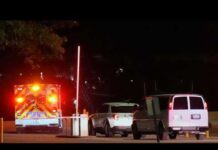
Polish police and firefighters rushed to a rural area between the villages of Tarnawa-Kolonia and Biskupice after residents reported a powerful explosion that shook windows in their homes in the early morning hours. Officers found a crater about 10 meters wide and scattered debris from what they called an “unidentified object” in a field roughly 2 kilometers from the nearest buildings. The site was quickly sealed off, and counter-terrorism units, military police, and prosecutors were sent in to secure evidence and keep locals away from danger.
Polish authorities say, for now, that there were no reported injuries and no direct threat to nearby residents. The impact zone sits in open land in Lublin Province, around 80 to 100 kilometers from the Ukrainian border, which helped limit the risk to people and property. Even so, the blast was strong enough that witnesses said the “windows nearly blew out,” showing that whatever hit the ground carried real force. Officials have stressed that the object remains unidentified and that investigators are still gathering debris and testing the soil.
How It Ties Into Russia’s War on Ukraine and NATO Fears
Polish military radar detected an unidentified object moving westward in Polish airspace at about 3:40 a.m., at the same time Russia was firing missiles at western Ukraine. An F-16 fighter jet was scrambled to intercept the target, but the object disappeared from radar after several minutes, leaving crews unsure if it had turned, broken apart, or already crashed. A military Mi-24 helicopter later flew over the area and helped pinpoint the likely crash site, guiding ground units to the crater on undeveloped land near Tarnawa-Kolonia. Air-raid sirens sounded in nearby cities, adding to public fear that the war had suddenly crossed the border.
This all unfolded during a large Russian missile barrage against the Lviv region, just across the frontier in western Ukraine. Ukraine’s foreign minister publicly claimed on social media that a Russian Kh-101 cruise missile crossed into Poland as part of that strike, calling it a violation of NATO airspace. Other reports and online posts quickly echoed that it might be a Russian missile that “came down on NATO soil,” even though Polish officials have not confirmed that version. This clash between cautious official language and loud geopolitical claims is exactly what many Americans now distrust about war reporting: the speed of the narrative often beats the facts.
Unanswered Questions and Why This Matters Beyond Europe
Right now, Polish authorities have confirmed only a few core facts: an unknown object entered Polish airspace, was tracked briefly, disappeared from radar, and a massive crater with debris was later found in a field. They have not said if the object was a Russian missile, a piece of a Ukrainian air-defense weapon, a drone, or some other device. That silence is not proof of a cover-up; it reflects that forensic teams need time to study metal fragments, explosive residue, and radar logs before they can name the source with confidence. People on both the right and the left know how often leaders have rushed to judgment in past wars and are wary of quick blame now.
This new incident also lands on top of older, confusing cases. In 2022, a blast in the Polish village of Przewodów killed two people during another Russian missile wave, and early talk centered on a Russian strike. Later, Polish and NATO investigations found that explosion was most likely caused by a stray Ukrainian air-defense missile, even while many still blamed Russia’s broader war for creating the danger. That history shows how fast-border explosions can be pulled into political stories before the science is done. For American readers who feel the “deep state” and foreign policy elites play games with information, this pattern in Poland looks familiar: the facts on the ground are simple, but the spin is not.
What a Careful, Citizen-Focused Response Would Look Like
If leaders truly wanted to calm fears instead of feed them, they would release clear, verifiable data once the investigation is complete: radar tracks showing the object’s path, lab reports on the recovered fragments, and basic maps of the crater and debris field. They would explain in plain language whether this was a direct attack, a stray missile, or some other kind of spillover from the war in Ukraine. That kind of openness would help ordinary people judge the risk for themselves and would push back against social media claims designed mainly to stir panic or score political points.
Poland scrambling fighter jets after an explosion is a serious escalation. 🇵🇱🚨 NATO airspace remains on high alert.
— Jerubbaal Ali (@AliJerub) July 30, 2026
For now, what we know is limited but serious. A foreign object entered the skies of a NATO country, emergency jets scrambled, sirens wailed, and a huge crater appeared in a Polish field as Russia’s missiles rained down next door. There were no casualties this time, but the message is clear: when wars are allowed to grind on, borders become lines on a map, not real shields. That is exactly the kind of slow-moving threat—managed by distant elites, paid for by regular citizens—that has many Americans asking whether their own government is truly focused on their safety and prosperity at home.
Sources:
insiderpaper.com, bbc.com, euronews.com, npr.org, washingtonpost.com, nytimes.com, nbcnews.com, en.wikipedia.org, youtube.com, news.yahoo.com, notesfrompoland.com, yahoo.com
© dailyanswer.org 2026. All rights reserved.