
(DailyAnswer.org) – A Nobel Peace Prize ceremony meant to honor courage and democracy instead highlighted how far a socialist dictatorship will go to silence its strongest voice.
Story Snapshot
- Venezuelan opposition leader and Nobel laureate María Corina Machado remained in hiding and skipped the Oslo ceremony amid death threats.
- Her daughter, Ana Corina Sosa Machado, accepted the Peace Prize on her behalf, turning the event into a symbol of generational resistance.
- The Nobel Committee explicitly honored Machado’s struggle to move Venezuela from dictatorship to democracy through nonviolent means.
- Machado has praised President Trump and US conservatives, aligning Venezuela’s fight with broader battles against authoritarian regimes.
A Peace Prize Emptied by Dictatorship
On December 10 in Oslo, the world watched an empty chair speak louder than any speech, as Nobel Peace Prize laureate María Corina Machado stayed hidden in Venezuela while her daughter walked the stage in her place. Security risks, death threats, and the real possibility of arrest or assassination made it too dangerous for Machado to leave the country. Instead, Ana Corina Sosa Machado received the medal and diploma, embodying both her mother’s courage and her nation’s suffering.
The Nobel Committee honored Machado “for her tireless work promoting democratic rights for the people of Venezuela and for her struggle to achieve a just and peaceful transition from dictatorship to democracy.” That language matters for Americans who care about constitutional government. It acknowledges what many on the right have warned for years: Venezuela is not dealing with a policy disagreement, but with an entrenched authoritarian regime willing to crush opponents rather than face real elections.
From National Hope to Targeted Dissident
Machado did not become a target overnight. A trained industrial engineer, she founded the civic group Súmate to monitor elections and later created the Vente Venezuela party to press for democratic reforms. After she challenged Hugo Chávez and then Nicolás Maduro, the regime escalated retaliation, expelling her from the National Assembly in 2014 and launching criminal proceedings. Those moves previewed a broader pattern Americans recognize whenever radical left governments consolidate power and sideline checks and balances.
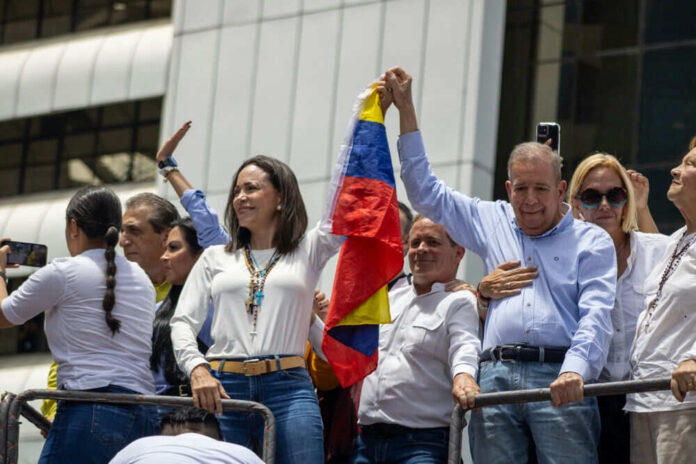
The tipping point came as Venezuelans tried to reclaim their democracy at the ballot box. In October 2023, the opposition held a primary, and Machado won more than 92 percent of the vote, securing a national mandate to challenge Maduro. Regime-controlled courts responded in January 2024 by upholding a 15‑year ban blocking her from office. When the July 28, 2024 presidential election arrived, the opposition backed Edmundo González as its candidate, claiming he actually won with close to 70 percent support, even as Maduro’s government declared itself victorious and clung to power.
Crackdown, Hiding, and a Dangerous Choice
After that contested election, the regime tightened the screws further. Human rights groups describe intensified persecution, attempts on Machado’s life, and a wave of threats and harassment that forced her underground by early 2025. Remaining in Venezuela, instead of accepting exile, meant living as a fugitive in her own country. When the Nobel Committee announced her as the 2025 Peace Prize laureate on October 10, the threats only grew, turning the simple question of attending a ceremony into a life‑or‑death calculation.
Ultimately, Machado concluded that traveling to Norway would expose her to arrest or assassination, either en route or upon return. That is how her daughter became the public face in Oslo, accepting the award while her mother stayed at an undisclosed location. The image resonates with conservatives who worry about what happens when governments decide dissent is criminal: parents forced into hiding, children stepping into the spotlight, and families carrying the burden of standing up to the state.
Why This Story Matters to American Conservatives
For many in President Trump’s America, Venezuela is not a distant curiosity but a warning about what happens when socialism, corruption, and contempt for constitutional limits combine. Machado herself has openly praised Trump and US conservative policies, crediting them with strengthening pressure on the Maduro regime and confronting hostile actors like Iran that use Venezuela as a foothold. Her Nobel Prize therefore doubles as a rebuke of globalists who once downplayed the crisis or treated Maduro as just another leftist leader.
Machado’s ordeal also exposes how fragile liberty becomes when courts, elections, and the media are captured by one political faction. A popular candidate wins a primary in a landslide, then is banned for 15 years. An opposition claims victory with documented support, yet the ruling party simply refuses to leave. The world responds with statements, but the regime answers with raids, bans, and threats. That script should sound uncomfortably familiar to anyone watching efforts to weaponize institutions here at home.
Generational Resolve and the Road Ahead
The sight of Ana Corina accepting a Nobel Prize on behalf of a mother in hiding offered a powerful picture of generational resolve. It told Venezuelans that their struggle is seen and that their movement is bigger than any one leader. It also reminded free societies that defending democracy and family values abroad strengthens those same principles at home. When a dictatorship forces a Nobel laureate into the shadows, it tests whether the free world still has the will to stand with those who refuse to bow.
Copyright 2025, DailyAnswer.org