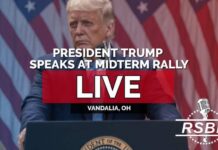

(DailyAnswer.org) – Washington signaled both a pause and a pressure play, as President Trump said a planned strike on Iran was on hold amid “serious negotiations” — a maneuver that highlights how life-and-death decisions can hinge on opaque backchannel appeals and leave the public guessing who truly calls the shots.
Story Snapshot
- Trump said a scheduled strike on Iran was postponed after appeals from Gulf leaders [1][2].
- Reports describe active military options and a meeting with national security leaders [3].
- Coverage ties the pause to hopes for renewed negotiations with Tehran [4].
- Primary-source confirmation of an execute order or formal delay remains unavailable [1][2][3][4].
What Trump Said And Why It Matters
News clips and summaries report President Donald Trump said he had been holding off on a planned attack on Iran “scheduled for tomorrow” and that he postponed it following appeals from leaders of Qatar, Saudi Arabia, and the United Arab Emirates [1][2]. Axios likewise reported Trump said he paused a plan to attack Iran and linked the move to requests from several Arab leaders, while also tying the pause to prospects for negotiations [4]. These statements, if accurate, indicate diplomacy directly influenced a near-term military timeline.
Reports also describe that national security deliberations included military options against Iran, with coverage referencing a scheduled meeting to review potential strike packages [3]. That context suggests the administration wanted Tehran to believe force remained on the table while diplomatic channels were opening. Such dual signaling is common in high-stakes coercive diplomacy, where leaders pair threats with talks to gain leverage. However, when details are relayed mainly through secondary coverage, the public cannot easily verify what was ordered versus what was floated.
Conflicting Descriptions And Verification Gaps
Sources differ on the precise target set, describing either a broader attack on Iran or strikes focused on power plants and energy infrastructure [1][2][3]. Outlets also vary on timing, with references to a strike “tomorrow,” “Tuesday,” or a short pause window [1][3]. These inconsistencies matter because they blur whether a fully approved operation was truly imminent or whether officials were signaling intent while preserving political and military flexibility. No primary-source White House transcript, Pentagon order, or original post is included to confirm exact wording or directives [1][2][3][4].
Axios reports Trump tied the pause to a “very good chance” of reaching an agreement with Iran, implying the delay functions as negotiating space rather than a standing down of force [4]. Wikipedia’s summary of the 2025–2026 talks notes that the President was reportedly provided options by the United States Central Command, reinforcing that military planning was active even as diplomacy unfolded [3]. Together, these accounts support the existence of a credible military option paired with a tactical diplomatic pause, while stopping short of proving a finalized strike package was ordered and then rescinded.
Regional Pressures And Shared Domestic Concerns
Coverage attributes the delay to appeals from Qatar’s Emir, Saudi Arabia’s crown prince, and the United Arab Emirates’ president [1][2]. That aligns with Gulf states’ longstanding interest in avoiding regional conflagration that could endanger energy flows and economic stability. For Americans, the story cuts in two directions: conservatives worry that hesitation projects weakness and invites aggression; liberals worry that opaque decision-making risks an unnecessary war. Both camps share a frustration that crucial decisions play out through selective leaks and fragments rather than transparent processes.
Energy markets and household budgets sit in the background of every Iran crisis. A strike on energy infrastructure could jolt oil prices and raise costs for families already strained by inflation. A pause that stabilizes prices could feel like relief, but voters on the left and right increasingly suspect that elite interests and secret diplomacy, not public accountability, determine when Washington chooses war or restraint. When the record relies on partial clips and not formal documents, those suspicions deepen [1][2][3][4].
How To Read The Signal Without The Noise
Based on the available reporting, three facts stand out: Trump publicly claimed to postpone planned strikes, he linked the pause to appeals from Gulf leaders, and he suggested negotiations now have a better chance [1][2][4]. A fourth fact is equally important: documentary proof of a finalized execute order or a formal halt has not surfaced in the supplied material [1][2][3][4]. The most cautious reading is that Washington used the prospect of imminent force to spur talks while keeping military options ready.
This moment reinforces a broader theme: the federal government asks citizens to trust consequential claims without providing timely, primary-source evidence. Americans across the spectrum—skeptical of entrenched elites, selective leaks, and shifting narratives—are right to demand verifiable records: original statements, call readouts, and declassified guidance. Until then, treat the pause as real in its political effect and plausible in military planning, but unconfirmed as a fully ordered strike that was definitively canceled at the eleventh hour [1][2][3][4].
Sources:
[1] YouTube – Trump halts planned Iran attack after Gulf leaders intervene amid …
[2] YouTube – claims to postpone Iran attack on Gulf leaders’ request
[3] Web – 2025–2026 Iran–United States negotiations – Wikipedia
[4] Web – Trump says he’s pausing plan to attack Iran – Axios
Copyright 2026, DailyAnswer.org